INTRODUCTION: Affordability in Context: Big Government and Big Debt Driving Big Costs

BY BRITTANY MADNI, President & Founder, Madni Strategies, LLC
Table of Contents
Introduction
An Accountability Crisis
Our Current Debt Picture
Government Is the Problem
Refocus on the American Spirit
Conclusion
 Download “Affordability in Context” PDF
Introduction
Affordability Is on Everyone’s Mind.
Politics today is anchored to affordability–or rather, unaffordability. The term is unavoidable and the tension behind it drives the current policymaking environment.
This is largely reactionary to how the American people have internalized the high cost of living, lingering effects of inflation, and concerns about the future. For many, that future looks challenging if not bleak; they worry the American Dream is slipping away if it was ever really there for the taking.
Economic uncertainty is pervasive and has resulted in an undercurrent of policies aimed at improving not only the actual pricing and accessibility of goods and services but also public perception.
Consumer sentiment is near historic lows. In other words, the affordability vibes are bad, and policymakers want to fix it. A word of caution, however: government efforts to “fix” damaged sectors are largely how we got into this precarious situation, and it will not get us out of it. Quick-fix reactions to shifting public sentiment and political pressure will only worsen the problem.
The fiscal state of the nation is dire, and the economic impacts of federal fiscal policy decisions can no longer be ignored. According to the most recent Congressional Budget Office baseline, “[t]otal deficits, net outlays for interest, and primary deficits are all projected to be large by historical standards.”1 The massive increase in recent deficit spending, particularly during the Biden Administration years, directly contributed to broad inflation.2 Matthew Dickerson found that “the average worker has seen the purchasing power of their take home pay fall by about $2,230 since the Biden Administration’s policies began.”3
Just the interest payments alone on our national debt for fiscal year (FY) 2025 totaled a greater sum than the gross domestic products (GDPs) of every country in the world but 16.4 At $1.22 trillion, the United States’s debt service costs for FY 2025 were approximately equal to the size of the Saudi Arabian economy.5 This contextualizes the scope and scale of government spending as Americans continue to pay the price (literally) of bad policy choices by policymakers who may not even be in office anymore.
Both parties share responsibility for greater federal overreach and the recent explosion of spending that has wrecked the economy and lopsided the federal budget. At the same time, today’s “affordability crisis” impacting even quotidian experiences like ringing up a full cart of groceries largely stems from the Biden regime’s spending binge.6 Perhaps a better way to discuss “affordability” is to question what made so much of American life cost prohibitive in the first place. When the Biden Administration sparked massive inflation through a combination of exponentially higher deficit spending and stifling overregulation, it did so in contravention of the American people’s primary needs and interests. Another layer of concern is a compliant Congress that rubber-stamped an extreme Leftist agenda under the false guise of COVID relief.
An Accountability Crisis
Perhaps one of the worst culprits of this frivolity is the Bidenomics Slush Fund, officially known as the Coronavirus State and Local Fiscal Recovery Fund.7 This $350 billion program was enacted through the American Rescue Plan Act, ostensibly for COVID response and recovery efforts. From funding pickleball courts to circuses to New York City’s trash bins,8 this supposedly critical deficit spending was never in line with Americans’ priorities for their tax dollars. This same program was even used to hand out $1,000 cash payments to illegal immigrants in Washington State, funneled through Planned Parenthood.9
Of course, the lesson here was that the government is happy to “take care of” any wants (not just Constitutionally acceptable needs), if you are willing to pay the price in the form of both your paycheck shrinking and your freedom being trampled. With waste and abuse of taxpayers running rampant through the federal budget, the so-called affordability problem has only worsened. The reality of the situation is that at the heart of the affordability crisis is the real problem: an accountability crisis. Collectively, this greater deficit spending stifled economic freedom, drove federal outlays to historic levels, and contributed to the most significant inflationary surge in four decades. The cumulative effect is a federal government larger in scope and spending than ever, more closely resembling failed socialist experiments than a dynamic, marketdriven government that enables every American to achieve prosperity and self-sufficiency.
Our Current Debt Picture
The U.S. national debt sits at $39 trillion at the time of this writing.10 That translates to approximately $289,000 per household across America. When you add in the unfunded liabilities across Social Security and Medicare, and the added debt service costs due to our ballooning interest payments, the total burden grows to $875,000 per household.11
Every American will suffer under this burden – be it from higher future taxes, higher inflation, or diminished attention to other critical government functions. Every dollar spent on government programs also grows the size and therefore influence of government in citizens’ daily lives. Our massive federal debt is already causing real impact: raising interest rates on Americans, dragging economic growth, and resulting in transfer payments that cause upward inflationary pressure on key sectors.
Rather than making prudent budget decisions to mitigate these negative consequences, the federal government is still running a $1.9 trillion deficit this fiscal year and continuing a trajectory of spending beyond our means.12 This is a clear failure of prioritization.
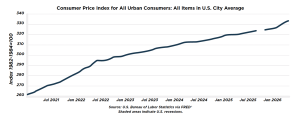
So how does this play out in real life? Unfortunately for the American people, the consequences come in the form of higher costs where it hurts the most. Since the start of the Biden Administration in January 2021, consumer prices have jumped over 27%.13
In January 2021, a pound of ground beef cost $4.31. The latest U.S. Bureau of Labor Statistics (BLS) data shows the same ground beef now costs $6.72 – a 56% increase for what used to be an affordable source of grocery store protein.14 The national gas price average the day before President Biden took office was $2.38; today it is roughly $4.50 for a regular unleaded gallon—though, as the energy chapter details, the latest spike stems largely from the closure of the Strait of Hormuz and will ease as that shock resolves.15 The same week in January 2021, the 30-year fixed rate mortgage averaged 2.77%; as of mid-June 2026, that number has jumped to 6.52%.16
Clearly, government intervention to “solve” the cost challenges across sectors Americans interact with every day has failed spectacularly.
Government Is The Problem
As President Ronald Reagan said, “Government is not the solution to our problem; government is the problem.” This is evidenced by increasing costs spreading and worsening across every sector the federal government attempts to “fix” with misguided policies.
From healthcare to housing, from education to energy, when government has involved itself, costs have increased while access has decreased. The federal government’s tentacles now creep into every part of American life like never before, threatening the opportunities available in a free market-driven economic system.
When politicians hear concerns from constituents about affordability and the high cost of living, many respond with fervor that subsidies must be deployed. This is the exact wrong tactic, as demonstrated by the so-called Affordable Care Act’s premium tax credits (PTCs, or “Obamacare subsidies”) and the recently expired enhanced-PTCs that were active under the Biden Administration. As the enhanced-PTCs’ sunset date approached, many lawmakers – particularly on the Left – scrambled to continue or even expand them further. Their fear stemmed from actuarial estimates of premium “increases” following the expiration, but these “increases” simply reveal the true expense driven by the Obamacare system.
As with all subsidies, the Obamacare subsidies enabled the federal government to make healthcare appear more affordable while actually increasing overall market prices and exerting major regulatory control over the personal healthcare decisions of every American. The federal government’s attempts to solve the healthcare affordability crisis failed to improve the situation because these policies were focused on masking the symptoms of a broken system rather than resolving its inherent challenges. In the case of healthcare, the bigger issue is not whether it seems too expensive for mass coverage, but whether quality, personalized care is accessible and truly affordable. Intervention, particularly through subsidies, resulted in poorly structured plans and narrow networks that limit care, further reducing access.17 Additionally, it spiked out-of-pocket costs, drove premiums higher, and opened the door to massive fraud.18
Subsidies and regulation function as a back door for government control and involvement in private industry. The only way to address the affordability crisis properly is to undo misguided government intervention and stop pretending more of the same will suddenly work.
So, how can the government get things back on track with affordability? By doing less, taking more accountability, and reorienting policy around the principles of economic freedom.
Refocus on the American Spirit
A natural outcome of more federal spending – particularly deficit spending – is bigger government. Higher outlays, no matter how well-intentioned, provide the government with greater influence and contribute to a paternalistic societal model. This, of course, is the antithesis of the American spirit.
Limited government, on the other hand, primarily achieved through less spending and regulation, not only helps our debt and deficit picture, but also protects freedom. Freedom is at the heart of the American way of life, opening up innovation, productivity, efficiency, human dignity, prosperity, and uniquely American opportunity.
To address the affordability crisis, we must first recognize it for what it truly is: a marker of reduced freedom and excess government control masquerading as a solution to a problem that government created.
Conclusion
The affordability question reveals the next stage of the government spending conundrum. The more the citizenry feels the pain of poor fiscal decisions, the more policymakers are tempted to paper over the problems with spending on shortterm fixes. That, however, will only worsen the crisis.
Why does this matter? The costs of bad governance are not abstract. They are felt by Americans every day in their grocery bills, mortgage rates, insurance premiums, and diminished economic mobility. The American people feel abandoned by policymakers in Washington, D.C., who are increasingly out of touch with how their decisions cause real harm. When special interests capture policymaking and distort outcomes, the result is not only economic inefficiency but an erosion of civic trust that breeds resentment for our neighbors. The effects are far-reaching and damaging to the social contract as a whole, breaking down the communal bonds that build stronger local and state government that can be more responsive to the day-today needs of the American people. Sustained overreach by the federal government, particularly during the COVID and Biden years, has compounded this dynamic. Progress has been made, but lasting improvements require Washington to meet the moment and commit to the structural reforms we desperately need.
This handbook provides pragmatic, sustainable solutions rooted in first principles to the problems underlying the high cost of living. It is only through deliberate, careful policymaking and reduced government spending that a freedom-forward option will re-emerge in troubled sectors. And with it, a more certain economy and renewed hope for the future.
Sources
1 Congressional Budget Office, “The Budget and Economic Outlook: 2026 to 2036,” February 2026, https://www.cbo.gov/system/files/2026-02/61882-Outlook-2026.pdf.
2 William W. Beach, D. Phil., “Is Inflation the Result of Excessive Deficit Spending?,” Economic Policy Innovation Center, February 9, 2024, https://epicforamerica.org/the-economy/is-inflation-the-result-of-excessive-deficit-spending/.
3 Matthew Dickerson and Amelia Kuntzman, “The Biden-Harris Administration’s Spending Binge,” Economic Policy Innovation Center, October 23, 2024, https://epicforamerica.org/federal-budget/the-biden-harris-spending-binge/.
4 Brittany Madni, “Interest Payments on the Debt Outpace Most Countries’ GDPs,” Economic Policy Innovation Center, December 3, 2025, https://epicforamerica.org/federal-budget/interest-payments-on-the-debt-outpace-most-countries-gdps/.
5 Ibid.
6 Dickerson and Kuntzman, “The Biden-Harris Administration’s Spending Binge,” Economic Policy Innovation Center, October 23, 2024, https://epicforamerica.org/federal-budget/the-biden-harris-spending-binge/.
7 Paul Winfree, Ph.D., and Brittany Madni, “The Bidenomics Slush Fund: How $350 Billion Is Being Misappropriated,” Economic Policy Innovation Center, December 3, 2023, https://epicforamerica.org/federal-budget/bidenomics-slush-fund/.
8 Brittany Madni, “Bidenomics Slush Fund Subsidizes NYC Trash – Literally,” Economic Policy Innovation Center, July 9, 2024, https://epicforamerica.org/federal-budget/bidenomics-subsidizes-nyc-trash/.
9 Brittany Madni, “Bidenomics Slush Fund Subsidizes ‘Undocumented’ Immigration,” Economic Policy Innovation Center, February 2, 2024, https://epicforamerica.org/federal-budget/bidenomics-slush-fund-subsidizes-undocumented-immigration/.
10 David Ditch, “National Debt Tops $39 Trillion,” Economic Policy Innovation Center, March 18, 2026, https://epicforamerica.org/federal-budget/national-debt-tops-39-trillion/.
11 Ibid.
12 Ibid.
13 Author’s calculations using data from the BLS and Federal Reserve Bank of St. Louis, “Consumer Price Index for All Urban Consumers: All Items in U.S. City Average (CPIAUCSL),” https://fred.stlouisfed.org/series/CPIAUCSL.
14 Author’s calculations using BLS data. U.S. Bureau of Labor Statistics, Consumer Price Index, “Average price data (in U.S. dollars), selected items,” https://www.bls.gov/charts/consumer-price-index/consumer-price-index-average-price-data.htm.
15 AAA, “Fuel Prices,” https://gasprices.aaa.com/.
16 Freddie Mac, “Primary Mortgage Market Survey Results,” https://www.freddiemac.com/pmms.
17 Brittany Madni and Sarah Wagoner, “The Biden COVID Credit Scheme,” Economic Policy Innovation Center, October 1, 2025, https://epicforamerica.org/federal-budget/the-bidencovid-credit-scheme/.
18 Brian Blase, Chris Medrano, Niklas Kleinworth, and Jackson Hammond, Paragon Health Institute, “The Greater Obamacare Enrollment Fraud,” June 2025, https://paragoninstitute.org/private-health/the-greater-obamacare-enrollment-fraud/.